


The Tate’s loss is a big win for Dallas.
Gavin Delahunty is slim, attractive in trendy black jeans, and seemingly swims in a veritable ocean of lyric enthusiasm. After an impressive stint at Tate (Liverpool), he joined the Dallas Museum of Art in the spring of 2014 as the Hoffman Family Senior Curator of Contemporary Art, and he could hardly be more optimistic about the new terrain he inhabits. He states that the museum is at a ?tipping point? in its history?a theory that will no doubt be proven when North Texas residents are offered a glimpse into his own pivotal moment in the museum?s timeline. Delahunty is curating his first DMA show in 2015, ?Frank Bowling: Map Paintings? (on exhibition February 19 through August 2, 2015).
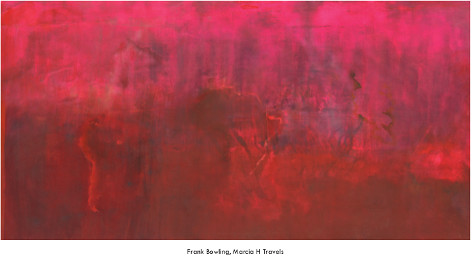
Without even the thinnest glimmer of conceit, he sees the upcoming exhibition as an important notch in Dallas?s belt when it comes to demonstrating the city?s capacity to operate at top speed as an international art hub. Delahunty notes, ?It?s time for us to lead the way?rather than be on the coattails of other (artistic) centers.? Thus, the Bowling exhibition is being posited as a double win. The artist is being offered a new venue in North Texas and the show is planned to kick off an expanded notion of the DMA?s stature vis-?-vis other institutions. In fact, to celebrate the occasion, the museum has acquired one of Bowling?s especially important works, Marcia H Travels, painted in 1970.
For the uninitiated, Frank Bowling was born in 1936 on the Caribbean coast of South America?in Bartica Guyana, to be precise?and is widely considered to be one of the most important figures to emerge from British art schools in the post-war period. To say his origins denote unlikely signs of someone who would later enjoy two Guggenheim Fellowships, membership in England?s Royal Academy of Arts, and an appointment as Officer of the Order of the British Empire (OBE) is an understatement. His father worked as a police district paymaster and his mother was a seamstress. This is the stuff of legend?which is appropriate since Bowling projects an immense presence in every sense of the term. Photographs of him disclose a sculptor?s dream of a face, with broad and striking cheekbones and a prominent forehead. He is typically clad in a suit jacket and a brimmed hat. In other words, he?s both elegant and intense, which is precisely what one would expect from a fellow who was named the first black member of England?s Royal Academy.
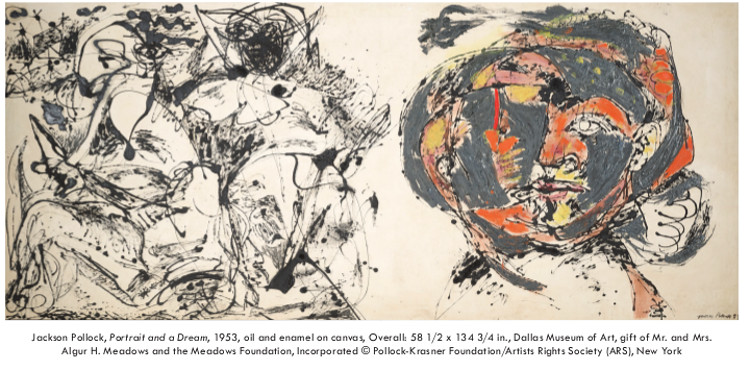
In a 1986 article in The New York Times, Vivien Raynor described his work as ?impressive painting that?strikes a balance between the African fetish and the dribbled images of Jackson Pollock.? To further whet appetites for the upcoming exhibition, Delahunty describes Bowling?s work as “phenomenological objects, immersive works.? In other words, he?s letting us know that we?re in for a kinetic firestorm in terms of new artistic topography. And, more importantly, this is not work that is readily found on other curatorial radar screens. Delahunty seems infatuated with things not yet seen, with art that heretofore may have only occupied the interstices of other grand exhibitions. He states that he ?learned so much from being with artists.? He looks bemused and then describes a trip he made to Bowling?s postage stamp of an apartment near the Tate in London. He throws his hands wide, ?It was only this big. Really tiny. I was taken there by Penelope Curtis because she knew about my interest in post-war art. That?s how it all began.? For background: Ms. Curtis is Director of the Tate (Britain) and speaks with a clipped accent about everything from politics, religion, and paintings exuding loneliness to a woman who died in a mental institution after an affair with Auguste Rodin. In the interest of full disclosure, I found videos of Ms. Curtis online because I wanted a sense of Delahunty?s past. I wanted to put myself in proximity to the proverbial ?sceptered isle? to gain a sense of the elevated haunts he had vacated. And then I wondered, ?Why leave? Why exit all of those centuries of culture and beauty??
Thus, I couldn?t help myself. I asked, ?You don?t miss London? Not at all?? He smiled and said, ?No. I really don?t. I have everything here. I spend time each day in our galleries. I have my books. I can find things online. No, I don?t miss it, not at all.? (Again, it must be the aforementioned ocean of enthusiasm to which he?s magically privy.) At any rate, Delahunty has yet another tour de force planned for the DMA in November of 2015, a show of Jackson Pollock?s ?black pourings.? The show is dubbed ?Jackson Pollock: Blind Spots? (November 15 through March 20, 2016), and it will feature lesser known work done by the artist that throws light upon Pollock?s signature pieces. Thus, we?re offered ingress into Delahunty?s passion for the off-road artwork, the ?blind spots? that can be revelatory moments in terms of understanding the arc of a career. The art being highlighted was created by Pollock between 1951 and 1953 and, in the words of Delahunty, will form ?the largest collection of ?black pourings? ever assembled.? He went on to describe the fragility of the pieces and the fact that they are in collections all over the world. Black acrylic on white (untreated) cotton duck is hardly the most stable of media, and the fact that they must be crated and packed for tremendous distances means that it?s unlikely that these pieces will ever be shown together again. Consequently, this could likely prove to be yet another intelligent play for turf, for yet another coup, when it comes to making the DMA a more formidable presence in the global art community.
Delahunty points out that the Japanese are particularly fond of the ?black pourings,? which makes sense given their streamlined, less-is-more sensibility. But, even more interestingly, he demonstrated Pollock?s method of applying paint on canvas. He stood up and pretended to walk around a work, moving his arms every direction as he hovered over a delineated space. ?This is what I call the mobile, airborne line. That space?that space between the brush dripping with paint and the canvas?transformed painting. We had never had anything like that before.? To underscore his point, he then sat and reiterated the more common notion of applying a brush to a canvas while sitting. It, indeed, is a different mode of creating work and, thus, is hinged to a quite different sensibility than Pollock?s ?action painting,? as it is often called.
Delahunty looked at me and, referring again to Pollock, said, ?And this, this was the beginning of the new universe.? He laughed and added, ?This is the sort of thing that is an endless fountain of happiness.? He obviously relishes the liminal space that artists occupy. ?Their membranes are thinner and they synthesize things in ways that are rare.? No doubt. The DMA is fortunate to have a curator who obviously is infatuated with contemporary art?and who loves Dallas so deeply. He said that he opted to ?move to Oak Cliff because of the texture, the different ethnic groups, and the fact that he has neighbors who are gay or Mexican. It makes it fun.? And his favorite places in the ?hood? Oak Cliff Coffee and Lucia?s. This proves Delahunty isn?t just a fabulous curator. He?s also a marvelous addition to the city. Why stay in England when Dallas has such big plans on the horizon? I, for one, am anxiously awaiting Delahunty?s two new exhibitions?as well as a new turn for the DMA and its bold new trajectory. If anyone can make this happen, it?s Gavin Delahunty?the luminous sylph who swims in a current of affability that is utterly irresistible. –P