


Ronan Day-Lewis discusses his works on view at Dallas Art Fair exhibitor Galleri Urbane
Among the artists’ exhibited at Galleri Urbane’s Booth B6 at Dallas Art Fair, Ronan Day-Lewis is an emerging standout. The son of Daniel Day-Lewis and filmmaker and novelist Rebecca Miller, he is a multimedia artist and filmmaker based in New York City. He holds a BA from Yale University where he was a member of The Control Group, an experimental theater collective.
In the fall of 2022, he was included in a group exhibition of “rising art stars” at Sotheby’s. Forthcoming exhibitions include a solo presentation at downtown Manhattan’s D.D.D.D. Gallery, and group shows at Kasmin Gallery and Winter Street Gallery.
PATRON caught up with the artist on the eve of Dallas Art Fair here:
Terri Provencal (TP): Born into a highly regarded artistic family, when did you realize you had to become an artist? And what were your earliest forms of artistic expression?
Ronan Day-Lewis (RDL): I can’t remember a time before making useless things felt like a necessity. My parents say I started drawing when I was two. They bought me an etch a sketch and I would draw motorbikes over and over. The second I was done with a drawing I’d erase it and start a new one. Then I got into dinosaurs.
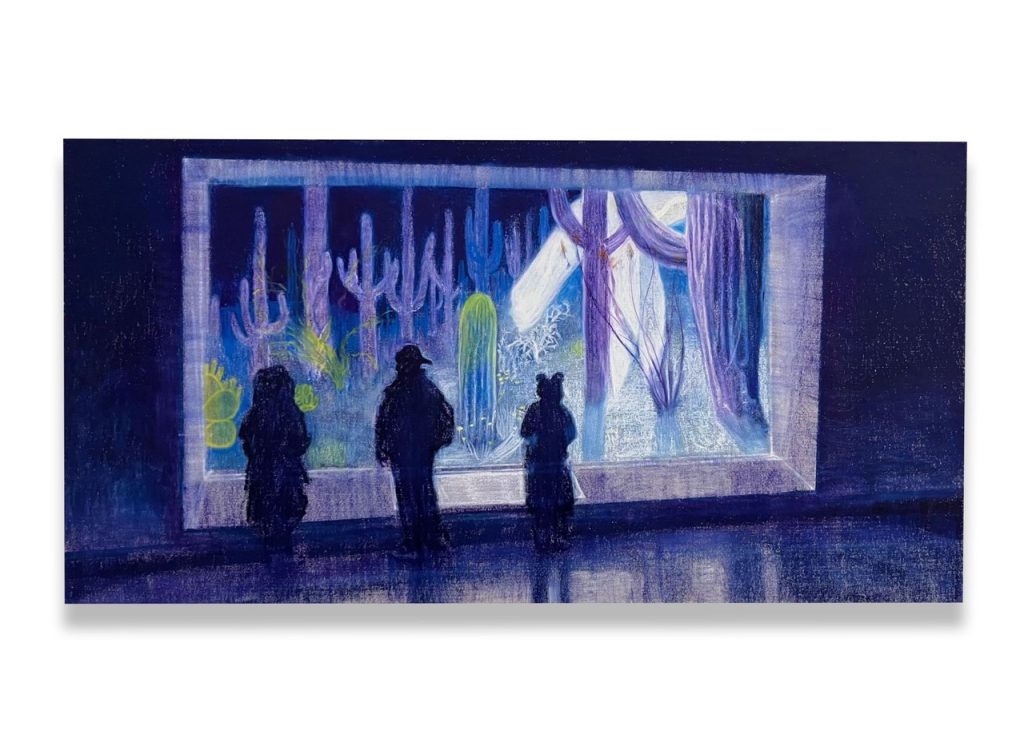
TP: You often depict pastoral scenes through windows. In Are You There Right Now? Do You Ever Get Lonely? the viewer sees a grouping of saguaros in a desert with a monolithic creature seemingly imitating the cacti. This ghostly being often reappears in your work. Will you describe its presence?
RDL: I protect the mystery of the creatures, even from myself—I think attempting to define them in words would be to strip them of that mystery. The first time one of them came to me, I was drawing on the floor, and this delicate, clumsy face began to emerge from a long, sloped neck. Its features had this strangeness to them, something unexplainable. It felt like the beginning of something.
TP: Have your paintings, recently populated with notions of the American West, for instance, been influenced by your experience as a filmmaker? Within both forms, there is also a sense of poetry and the sublime in your work like the official music video you created for Philip Glass’s The Somnambulist, interpreted by Katia and Marielle Labèque.
RDL: I think of painting and film as two expressions of the same impulse. Not just formally, but also in the feelings they chase. Recently I’ve been making paintings in this hyper-wide aspect ratio, which has a relationship with the anamorphic film lens. There’s an artificiality, a make-believe to filmmaking which I carry over into painting. I like to make a world and go inside it.
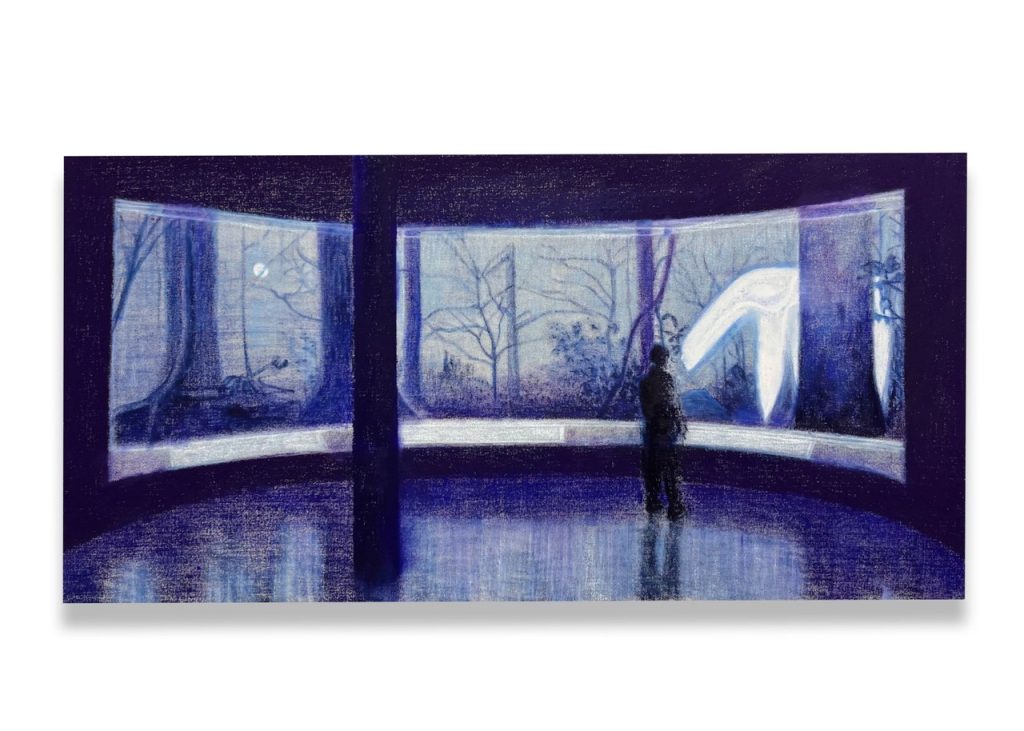
TP: In The Familiar (If I Reached Out My Hand, Would You Come To Me?), we see two solitary figures regarding one another on opposite sides of a curved window. You often investigate inaccessibility in your paintings, and we feel this sense of longing here. What sources of inspiration do you turn to when creating your work?
RDL: Painting is a reaching for the sublime, something that’s ultimately unreachable. There’s a sadness to that, but also something beautiful. I’m interested in the places where words fail.
TP: As with most endeavors there is inevitably a trial-and-error period. When did you feel one of your paintings was completely successful and you were ready to show it?
RDL: For my thesis, I made this triptych, a retelling of the biblical fall painted on three different patterned fabrics stretched over a big, hinged wooden altarpiece. There was a stuffed fabric snake draped over the top of it. It felt complete to me.
TP: Your career is on the rise with several exhibitions in 2023 including SMWR ELSE curated by Ambre Kelly and Andrew Gori at Spring/Break Los Angeles in February, and a forthcoming group show at Winter Street Gallery. Plus, this is the first time your work will be shown at Dallas Art Fair with Galleri Urbane. Will you attend Dallas Art Fair? Have you visited Dallas previously?
RDL: I’ve never been to Dallas. I’d like to go to the fair, but I’m also knee-deep in working on a large-scale sculpture for another upcoming show which is pretty all-consuming at the moment, so it’s hard to tear myself away.
TP: We understand you have a forthcoming show at Kasmin. Your work will be shown alongside art giants Alex Katz, Lee Krasner, Robert Motherwell, and Dorothea Tanning. Alex Katz was honored here at TWO x TWO for AIDS and Art in 2019, and it was a huge treat to have him in Dallas. Please tell us more about the exhibition and your inclusion in the show.
RDL: The show is alongside an auction for a nonprofit called Artistic Noise—they organize art-making experiences for young people whose lives have been impacted by the juvenile court system. It’s a cause I believe in strongly. And the idea of showing with some of my painting heroes is surreal… Katz’s work is especially important to me. I made a new night-time painting for it which I’m excited about.
TP: You met Ree Willaford with her daughter Camille in Marfa in 2006. Camille performed in a play you had written. Marfa has that uncanny sense of creative conception running through its West Texas veins. Have you returned to Marfa’s siren call?
RDL: That time I spent in Marfa is one of my most important experiences. The feeling of the place still finds its way into my work. I’ve never been back, which I think in some ways has strengthened my memories of it. I dream of going back.
TP: Where will we see you five years from now?
RDL: Still making personal work—that’s all you really have control over. I’m also currently in development on my first feature film, which I hope to have gotten to make by then. In both painting and film, I just want to keep pushing myself, taking risks.