


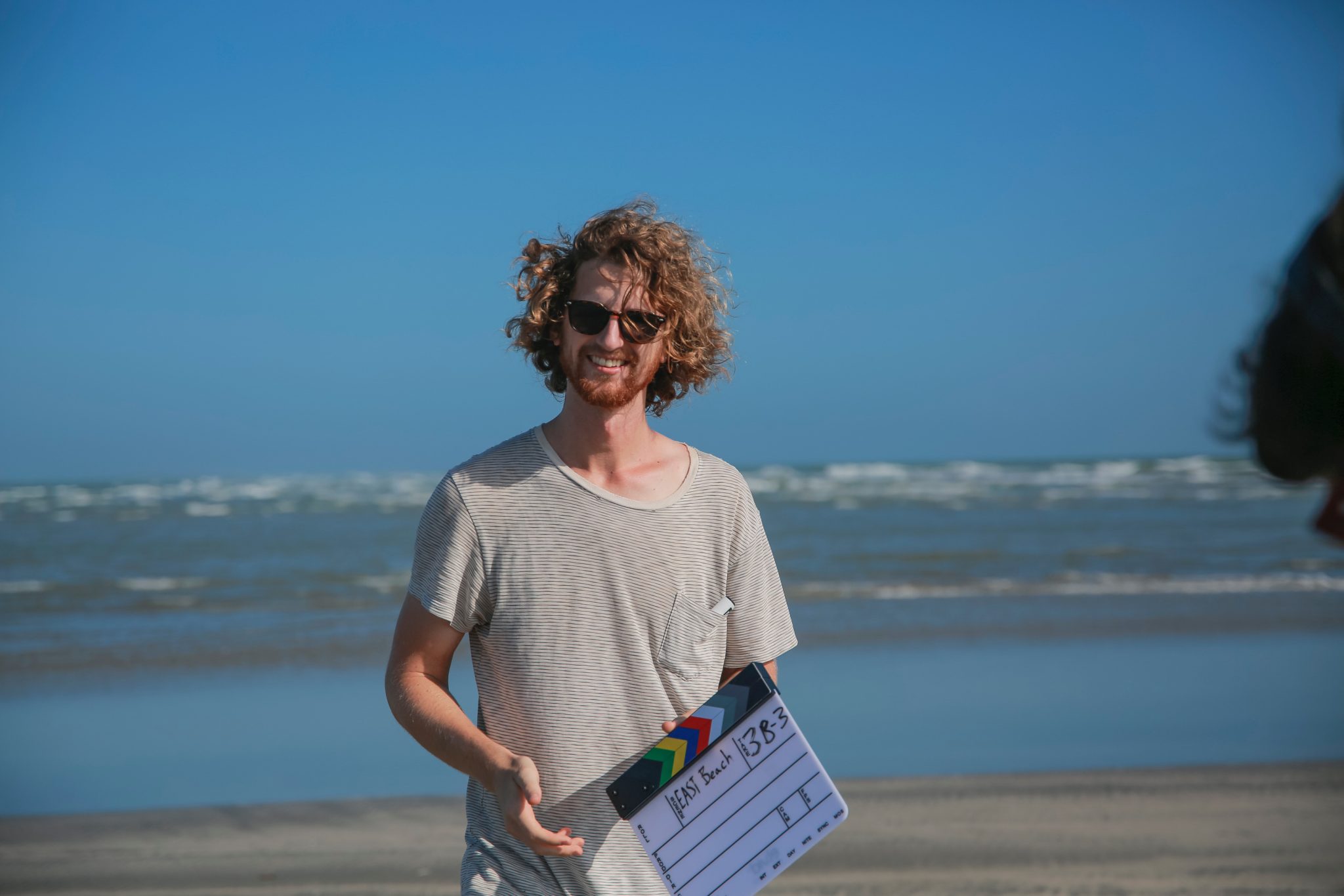
In IT IS A GOOD PROJECT AND SHOULD BE BUILT, artist and filmmaker Fred Schmidt-Arenales dissects the bureaucratic unconscious behind one of the most ambitious and admittingly troubling, proposed infrastructure projects in the United States: the Texas Coastal Barrier Project, better known as the Ike Dike. Through a blend of documentary observation, speculative performance, and musical interludes, Schmidt-Arenales renders the procedural theater of power as an act of belief in progress, authority, and the sanctity of “good projects.”
His lens turns the language of governance inside out, revealing the paradox at its core: a seawall designed to protect a petrochemical industry that fuels the very storms it seeks refuge from. In this conversation, the artist traces how bureaucratic conviction becomes myth, how fantasy becomes document, and how doubt (unwelcome in official discourse) can become a form of resistance. What emerges is less an exposé than an excavation of collective imagination: a portrait of a society building toward its own undoing, one meeting agenda at a time.
PATRON: The title IT IS A GOOD PROJECT AND SHOULD BE BUILT reads like a statement of bureaucratic conviction, yet the work complicates that certainty. What drew you to those words, and what tone or tension did you want them to carry?
Fred Schmidt-Arenales: The title comes from an archival document I saw in the Rosenberg Library in Galveston, in the Army Corps of Engineers file there. The document is an explainer for how the regulatory and governmental process for Army Corps of Engineers projects get made (I’m attaching the page here). The comic shows the Kafkaesque series of steps that any project has to go through and the various levels of government that need to sign off, authorize, approve, fund, etc, etc. One of the panels features some stick figures telling another stick figure that “it is a good project and should be built,” just like you say, full of bureaucratic conviction. The cartoon gives the impression that every project is a good project, and they should all be built. From my time studying and watching and talking to the Army Corps, I got the sense that for that organization, the world is defined by projects and the journey towards building them. Their imperative is to build projects, not, necessarily, to ask if they should or should not be built. For me this is all wrapped up in the title IT IS A GOOD PROJECT AND SHOULD BE BUILT, along with the obvious shadow of that idea, the question that immediately springs forth, which is: is it a good project, should it be built?
P: You often describe your work as exploring the unconscious dimensions of civic life. Where did you find the unconscious in the Texas Coastal Barrier Project, in its language, its myth, or its visual culture?
FSA: When I talk about the unconscious, usually I mean the unconscious dynamics that play out in groups of people who are engaged in some kind of work. In this case, the work that I was interested in was the various activities related to the Texas Coastal Barrier project and its advocacy. My understanding of these groups and what I can glean about what might be going on under the surface is limited to moments where I can observe or participate in those activities. Those were precious few in this case, I was limited to a monthly meeting of the Gulf Coast Protection District (GCPD), some public facing events that the Army Corps or GCPD held, any public recordings, documents, media, webpages, that I could access, and direct conversation and interviews that they would grant me (only one as it turned out). So I’m literally talking about the unconscious (individual and collective) of the people involved with the project. Then comes projection and speculation, where I take my observations and make guesses and draw inferences about what might be going on. Then I asked my collaborators Anne Lukins and Andy Davis to dream with me about these fantasy scenes. I shared with them what I observed and we pooled our own unconscious associations and came up with what you see in the film.
P: This piece combines documentary footage, staged performance, and music. What does that hybrid form allow you to express that a traditional documentary could not?
FSA: The hybrid format allows me to play more freely with ideas and emotions that might be hard to access in a documentary format without being too didactic for my liking. Foremost is the feeling / thought that the whole problem might be overwhelming, that there might not actually be a good solution to the problem. That’s not something that the Army Corps or of the various governments involved are equipped to deal with – or really any part of our society. We are not, generally speaking, equipped to deal with doubt, uncertainty, failure very well. Mostly we dissociate (especially at a collective level, or in “official” channels). So, the hybrid elements (performance, fantasy, music) are ways of getting viewers to actually sit in those feelings and stay with them.
P: The Ike Dike promises protection while preserving the industries that intensify the storms it is meant to defend against. How did you approach that paradox without reducing it to simple irony?
FSA: One of the definitions of irony (Merriam-Webster) is “incongruity between the actual result of a sequence of events and the normal or expected result.” I suppose here the irony is that you would expect that building a seawall might protect Houston from storm surge, but in fact what is happening is that in doing so, we’re protecting the petrochemical industry and allowing it to continue its activities, and thus further endanger what we want to protect. Some more irony enters the picture when you know that the Army Corps is trying to package a number of “ecosystem restoration” projects in with the Coastal Barrier and then justify the project on the basis of those “green” elements, in attempt to greenwash the whole project, which will indisputably maim and potentially kill the ecosystems of Galveston Bay.
The one liner / elevator pitch for the project that I often deploy when I need to say something quippy about the project and don’t have time to unpack it fully is some version of: “The US government wants to build a giant wall in the ocean to protect the oil industry from the dangers of hurricanes which are becoming more dangerous due to global warming.” In the work itself I do lots of things to flesh out that picture. I talk to the proponents of the project about the real concerns that they are trying to address. I bring in fictional characters to talk about historic places that defied the region’s Hurricanes to disastrous effect. I use stand ins for the GCPD members to try to unpack what might be going on in their minds, even if they aren’t fully aware of it. I criticize the un-democratic nature of the process.
P: When you film procedural hearings or Corps officers, what interests you most, the content of their words or the performance of authority itself?
FSA: You’re zeroing in on the core of something here, the rituals of authority are a central interest for me. In the bulk of the material I filmed, the meetings were pretty clearly a formality, nothing was actually happening in them. The words themselves were painfully boring. The Board of Directors would move through a series of predetermined sections set out in the agenda and each was more or less a report on something that happened elsewhere, or a notification of something that would happen in the future, or a presentation by a third about work or decisions that had been or would be made in another place at another time. So yes, these meetings were purely a moment in which the governmental body had to go through the motions, but in doing so, they were actually enacting policies and, agenda item by agenda item, moving something (the Texas Coastal Barrier) closer to existence. That’s the funny thing, nothing was happening and yet, as things were declared and described and motions were made and seconded, this one small governmental body entered events and concepts into the official record. Like clockwork, near the end of the meeting, the board would go into executive session, away from the eyes of the public, to make the real decisions. But even this process felt staged: they would all leave the room and keep the public in attendance waiting, only to re-emerge about 20 minutes later with an air of gravitas, having made some undisclosed headway. One or two more items might be addressed and then the meeting would be briskly adjourned.
P: How do you translate a multi-billion-dollar, two-mile-long barrier into something a viewer can feel rather than just understand intellectually?
FSA: You can’t really, I think. It’s not an object that can exist in a comprehensible relation to a human – it’s an object at an inhuman scale, and dealing with forces that are beyond our capacity to grapple within an immediate sense. It’s in that category of things that one can try to conceptualize but can’t actually relate to. I find it similar to trying to imagine a really large number – like a million. A million dollars, a million apples. It’s just a lot of apples, and more apples than I could ever even think about relating to. I will never even come into proximity with a million apples (maybe if I was an apple picker I would walk by a million in my lifetime, but not all at once).
So, then I have to relate to it as something that I can’t fully understand. It becomes a mediated experience, my emotional reactions are determined by what I think they should be, and that process of internal conversation becomes the material / medium of my emotional reaction. This is how I relate to the Ike Dike (and other mega objects like it) and so I’m just assuming that that’s how other people relate to it as well. But then something interesting happens. The process of mediation that happens when I try to relate to this inhuman idea / object, that process actually very closely resembles how film (and other art) works.
P: Environmental conversations often revolve around the idea of resilience. What does that word mean to you after researching a structure designed to hold back the sea?
FSA: There is a big debate about the concepts of resilience vs. the adaptation to climate change. Adaptation is defined by the IPCC as the process taken to “adjust to the actual or expected climate and its effects.” This would include things like seawalls to protect from rising sea levels and storm surge. Resilience is talked about as the capacity to prepare for, respond to, and recover from hazards. The concepts are similar and often overlap, but resilience is often seen as a more holistic concept involving system wide changes to societies, mindsets, and then policy and infrastructure. It’s too much to really get into here but I find it useful to think in terms of reactive vs. proactive changes and responses. In these terms, the Texas Coastal Barrier would be a reactive adaptation, it’s meant to protect against an already demonstrated threat, and in no way does it proactively anticipate future changes or different threats (or the adverse effects of itself).
But, incredibly, for all of its $72 billion price tag, the Texas Coastal Barrier has almost nothing to teach about either of these concepts, because the plan doesn’t come close to meeting the standard of either one. It’s clearly not a proactive approach, in so many ways. For one, its primary mission is to protect the petrochemical industry from storm surge, so that industry can keep producing. This has to be the furthest thing from a proactive approach that I can think of. On top of that, the plan promises to cut the flow in and out of Galveston Bay by around 30%, and if you talk to anyone who knows anything about these kinds of ecosystems, tidal flows are everything. Imagine a bottle with a small community of fish living in it, those fish rely on clear, oxygenated water being able to flow in and out of the opening of the bottle to survive. Then imagine putting a cap on that bottle. That’s functionally what the Coastal Barrier would do – you’re limited the transport of nutrients, salinity, and other important factors in and out of the bay. When we talk about climate resilience, so often we talk about healthy ecosystems, and especially wetlands, right? Because wetlands do a lot of amazing things, including carbon sequestration.
In terms of adaptation (what I’m terming the reactive approach), the plan doesn’t account for anything close to the worst-case scenario storms. So, in all likelihood (if it ever gets built, which I doubt), it will be overtopped by storms that are increasingly proving to be bigger than our wildest predictions.
P: You describe the work as both fantasy and document. Do you see the fantasy elements as critique, catharsis, or prophecy?
FSA: All of the above. The fantasy elements are there for the viewer to have their own associations. They are open for interpretation. I have my own ideas that they sprang from but I think other people’s readings of them are more interesting, so I don’t want to say what I think they are. What do you think they are?
P: After completing this project, what stays with you? Has making IT IS A GOOD PROJECT AND SHOULD BE BUILT changed the way you think about the role of art in civic imagination or your own responsibility as an artist?
FSA: The whole process behind the Coastal Barrier shows regard only for status, blind subservience to what we call the “economy”, and a complete lack of imagination for anything other than the status quo and prolonging it as much as possible. It’s completely bereft of anything that might actually move us out of the terrible situation we’ve found ourselves in. My best, most generous guess at what happens is that the people who mean well and get into politics or whatever position of power for the right reasons are just frozen with uncertainty at the scale of the problem, and this leaves the greedy and corrupt to just make hay for themselves and their buddies at the prospect of a government megaproject. Far and away the largest constituency of attendees at any of the GCPD meetings were representatives from construction and engineering firms – the people who would be granted the government contacts to construct the project. The main question in all of the meetings was “how are we going to make this giant construction project happen,” as opposed to, “what should we do about this intractable issue.” Unfortunately, the question of what to do about it was left to the military, that bastion of intellectual and moral clarity. It’s a fitting end for our society I think, that we’ve A) created a problem through our massive industrial output that for all our might we can’t solve with more steel and concrete and B) that we’ve so disempowered and devalued the ideals of critical thought, scientific inquiry, and moral reasoning that we’ve literally given biggest questions of our time to a branch of the military, essentially an institution of professional murders, to solve.
I know that doesn’t really answer the question but that’s what I took away from my deep dive into the Texas Coastal Barrier.
As for the artist’s civic responsibility, I think that artists, importantly, don’t have a civic responsibility. Civic responsibility is for the realm of governance. In my ideal world art making is something that everyone does because it is a spiritual and intellectually nourishing thing to do. Leave it to our sick society to concentrate that activity into a small group of over-professionalized, highly educated elites and suck all the joy out of it by turning it into just another “career.”
Schmidt-Arenales’s final words carry the exhaustion of someone who has spent years inside the machinery he documents a weariness that itself becomes testimony. His rejection of the artist’s “civic responsibility” reads less as abdication than as refusal: a refusal to participate in the same structures of authority and conviction that his work critiques, to offer solutions where the conditions for meaningful action have been systematically dismantled. What remains is the work itself, a document of collective fantasy and individual witness, an artifact of a society that knows how to approve meeting agendas but not how to sit with doubt.
In this sense, IT IS A GOOD PROJECT AND SHOULD BE BUILT functions not as answer but as mirror, reflecting back the rituals through which we authorize our own undoing. If the artist refuses civic responsibility, perhaps it is because the work demands something more difficult: that we recognize the difference between building projects and asking if they should be built at all. That distinction, Schmidt-Arenales suggests, may be the only territory left for genuine resistance, not in the meeting room, but in the uncomfortable space where certainty breaks down and different questions become possible.