


Bruce Wood Dance Dallas closed its sixteenth season with IGNITE, a three-work program that made good on its title. Presented June 12–14 at Moody Performance Hall, the evening brought together a world premiere by artistic director Joy Bollinger, a Dallas premiere by Jessica Lang, and a return to the company’s roots with Bruce Wood’s Zero Hour.

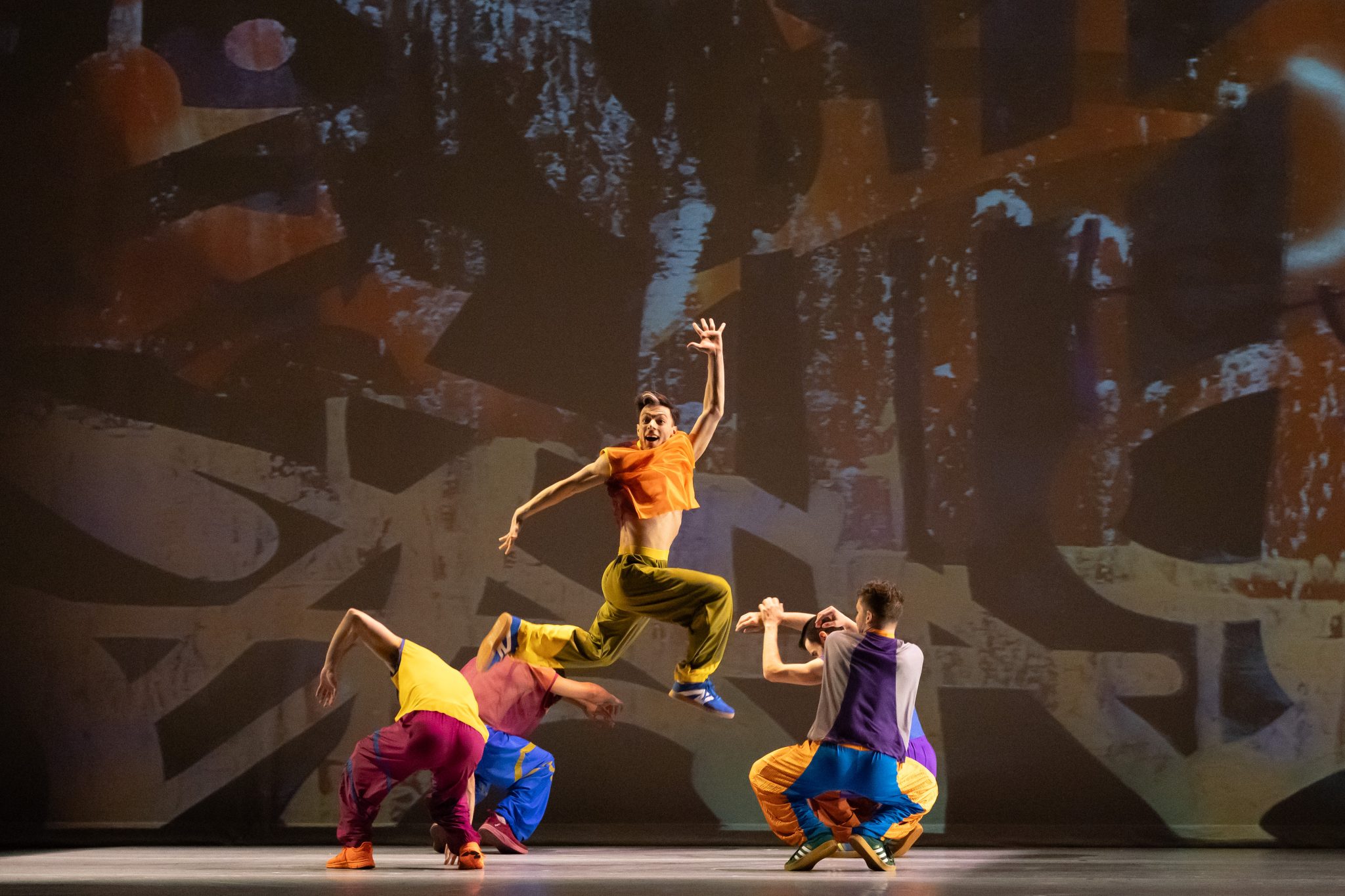
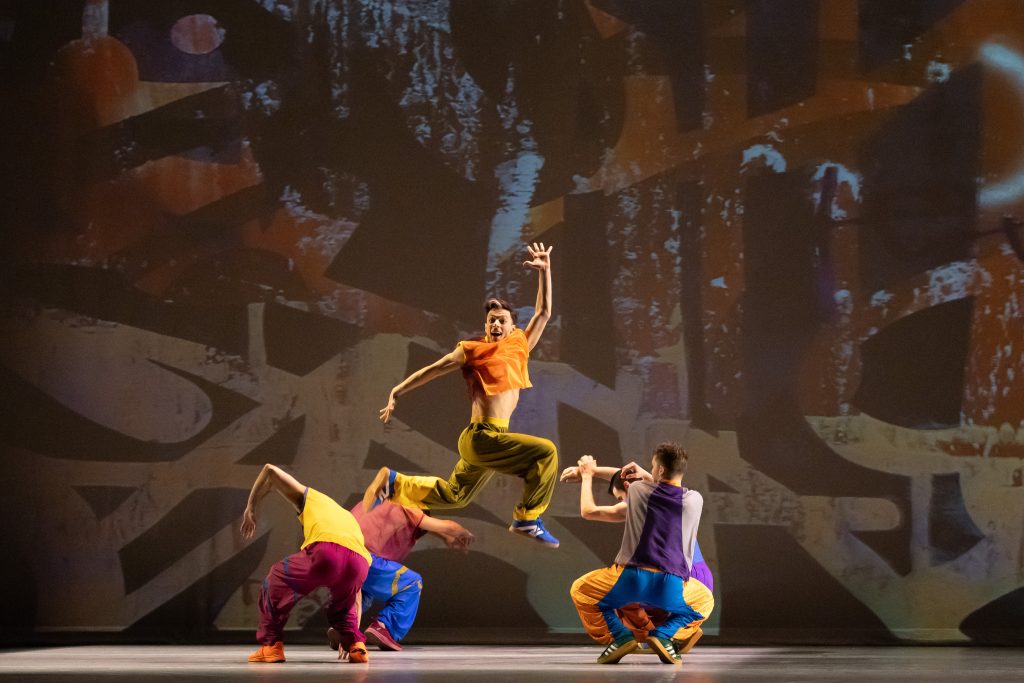
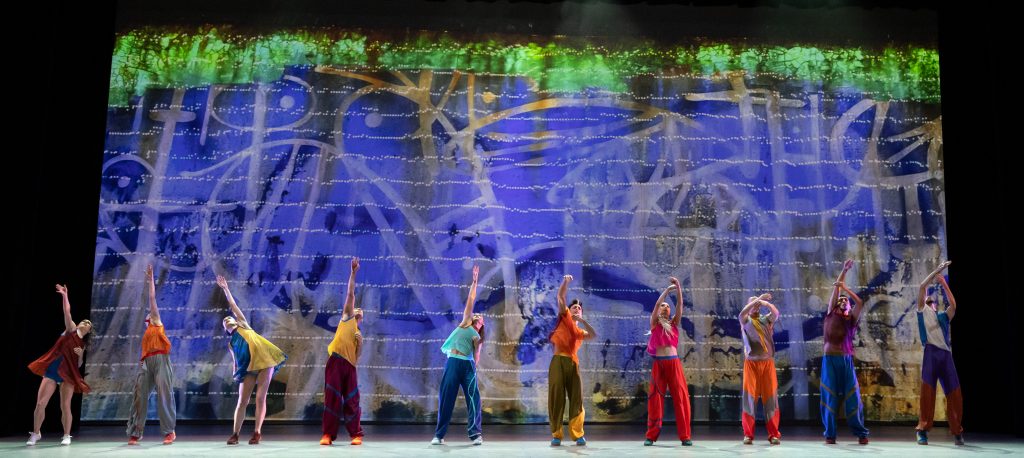
The program’s opening work, Bollinger’s MOVE, gave the evening its most immediate visual charge. Created in collaboration with visual artist JM Rizzi and projection designer Courtney Ware, the premiere turned the stage into a moving canvas. Rizzi’s large-scale gestural language, familiar from murals and paintings that carry the marks of graffiti, jazz, urban texture, and abstraction, was expanded through Ware’s projection design into an immersive environment of light and color.
The projected imagery acted like a second body onstage. Lines stretched and dissolved. Fields of blue, green, orange, and black opened into shifting surfaces. Marks appeared to pulse, float, drip, and scatter, meeting the dancers in motion rather than holding still around them. The result was a work that treated painting, projection, sound, and choreography as parts of the same kinetic system.

Bollinger described MOVE as a work built around “that electric moment when different worlds meet.” Set to a score by Levi.Sct, which layers classical piano with hip-hop and techno, MOVE placed refinement and rawness side by side. The dancers moved through crisp unison, suspended balances, lifted bodies, and grounded bursts of energy, their movement vocabulary pulling from technical contemporary dance while brushing against the release and attitude of street movement.
There was a productive tension in the contrast. Classical piano gave the work moments of clarity and precision, while the beat-driven sections pushed it toward speed, weight, and attack. The dancers responded with a physicality that felt bright and immediate. At times, they seemed to be tracing the projected marks with their own limbs. At others, they cut across the imagery, interrupting it with jumps, tilts, catches, and sharp directional changes.
The collaboration also marked an expansion of how Bruce Wood Dance Dallas can occupy a stage. The company has long been associated with emotionally direct, physically articulate work, but MOVE pushed that language into a more explicitly multimedia frame. Ware’s projections did not overwhelm the choreography; they gave it another scale. Rizzi’s marks became part of the rhythm. Bollinger’s dancers held the center, grounding the visual field in human force.
If MOVE looked outward, Jessica Lang’s To Familiar Spaces in Dream turned inward. Receiving its Dallas premiere, the work brought a more meditative register to the evening. Lang’s choreography, shaped by a refined sense of image and atmosphere, offered a dreamscape in which memory seemed to fold back on itself. Where Bollinger’s premiere drew energy from collision, Lang’s work drew power from suspension, intimacy, and transformation.
The program closed with Zero Hour, choreographed by Bruce Wood and set to tangos by Astor Piazzolla and Lalo Schifrin. As a repertoire staple, the work returned the evening to the company’s foundation. Its sensuality, restraint, and rhythmic heat offered a different kind of ignition, one rooted in Wood’s ability to make tension feel elegant and desire feel architectural.
That balance gave IGNITE its larger shape. Bollinger’s leadership has continued to honor the company’s namesake while opening space for new collaborators, new technologies, and new visual languages. By the end, IGNITE felt like a fitting title for a program built on contact: between choreographers and artists, between repertoire and premiere, between the physical and the digital, between what Bruce Wood Dance Dallas has inherited and what it is still becoming.