ZHULONG, A CHINESE MYTHOLOGICAL DRAGON KNOWN FOR CREATING LIGHT AND DARKNESS BY OPENING AND CLOSING HIS EYES, INFORMS A NEW MEDIA GALLERY.
Dragon Street glowed in 2014 with the opening of Zhulong Gallery, with its slick, opaque, white-glass exterior and rooftop patio that boasts some of the best nighttime views of Dallas. Aja Martin, the gallery?s director, works with artists who engage with the prevalence of technology in the everyday.
Offering video, digital, post-internet, new media, and all things associated to Dallas, Martin says: ?That?s what our space was built for, and where we want to be on the cutting edge.? Other than the Dallas association, this concept was largely new to the local collector who may have seen occasional video installations at various local galleries, but not a gallery dedicating its entire programming to new media. Art collector Evan Stone caught up with Aja Martin following a successful debut at the Dallas Art Fair.
EVAN STONE (ES): What does the gallery name Zhulong mean?
AJA MARTIN (AM):Zhulong is actually a Chinese deity of light. He is a dragon who creates the light of day and the darkness of night with his one vertical eye. Given our location on Dragon Street, our glowing facade, and our focus on technology?think open eye ?0? and closed ?1?; or binary code?the name has come to be really meaningful.
ES: You mentioned the space and also specifically the fa?ade; talk to us a little more about the design of your space and why it is particularly relevant to your mission.
AM: The building facade is a 17 x 10-foot projection surface essentially. It?s outfitted with special frosted glass that allows the image of our projector to shoot through the glass to the outside of the space. We also have an LED feature that is repeated on the pergola above, and it allows the building to glow and sort of float. The artists are usually very excited about the opportunity to program the exterior with an existing piece, or create an original light treatment. Inside, the layout of the space allows for a great deal of flexibility. We?ve projected live-energy meter readings in a 15-foot real-time circular data set onto the gallery floor. Tega Brain, Kilowatt Hours, exhibited 12 video works in a solo exhibition for Lauren Woods. In another exhibit, a 40-foot table sculpture served as a programming opportunity to host a dinner series on. I?m constantly amazed at what our artists bring to the table. They really step up to the exhibitions we put on together; we?re so thankful. It?s great to see the technological capabilities of the building pushed in all sorts of directions.
ES: Tell us a little bit about selling new media art. Do you find it difficult for local collectors to grasp the concept and make a purchase?
AM: The gallery focuses on art and technology, so we have all mediums. You?d be surprised at how many artists successfully incorporate technology into a larger practice of object making. But, the moving image, net-art, and 3D-printed sculpture have been the hottest for us in our first year, and that makes me excited. We also have a level of comfort with answering any questions related specifically to media installation, so there is little hesitation about medium once someone connects with a work.
ES: One concern traditionally with new media art (if you?ll allow us the irony) has been the rapid obsolescence of the delivery technologies themselves and the resulting challenges in preserving the art?does this continue to be an issue from an artistic or commercial point of view? How should a collector think about this?
AM: It?s hard for me to imagine that the works of art we exhibit are at a point now where the evolution of things, technologically speaking, is so rapid, it?s a given. But that constant evolution has led to a more fluid realm, overall, where new formats are introduced, and things are updated and converted accordingly. Advances in technology have also made it so that most works can be realized in some form or fashion.
Also, our artists are aware of this discussion and tend to work in ways that help reinforce the longevity of the works. There are at this point, I?ve experienced, several standards within this space of art-making: Consensus is a palpable and active thing in this realm; there?s a sort of utopian collectivity and willingness to problemsolve, which are also apparent in the work.
ES: You were doing something specific at the fair; what was your booth about?
AM: I wanted to show people that ?art and technology? as an umbrella is not all ephemeral works, but also things that are tangible, and things that can be as beautiful as older, historical museum objects. A lot of what we do is about informing our guests. I use curating as another way to communicate about the work that we show and place. So, our booth had an archival quality even though we showed video-game stills, 3D-printed sculpture, video, Autodesk ?skins,? and websites. Time was a subject?many of the works illustrated the new way we see the old, given our predilection for technology.
ES: Which artists will you be showing this summer at Zhulong?
AM: We won?t slow down for summer! On May 15 we opened my shoes, my stove, my life, a solo exhibition of digital works on canvas by London-based artist Luke Dowd that continues through June 20. And, in late June we will open a two-person show with Jimmy Baker (US) and Mattie Hillock (US), two artists we are excited to be working with who have very distinct approaches to the additive and subtractive possibilities of image-making and paint. Also, everyone should keep an eye out for details about our Solstice Eve Charity Event on June 20. It?s going to be a night to remember. P
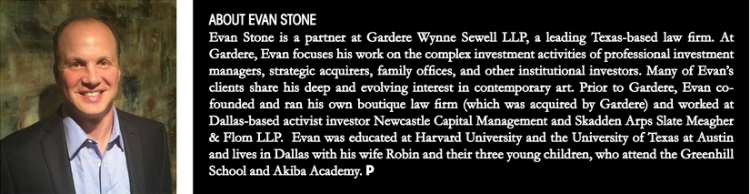
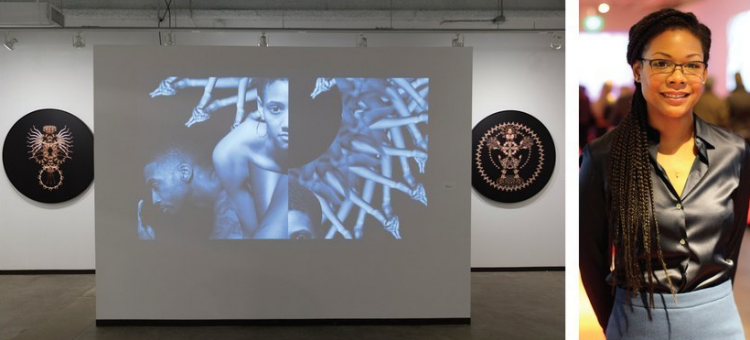
Above, left: Installation view from the Zhulong Gallery booth at the 2015 Dallas Art Fair. Above, right: Aja Martin, Gallery Director, Zhulong Gallery. Below: Evan Stone.