


Last Saturday, Conduit Gallery was alive with the opening of Johnny Floyd’s I Am the Spell—an exhibition that blurs the line between painting and ritual, image and invocation. Through layered, gestural processes, Floyd creates works that are not merely representations but living records—spells—rooted in Black memory, materiality, and presence. In a moment shaped by automation and erasure, these paintings reclaim space, time, and authorship, offering viewers a visceral experience–something to feel, witness, and carry forward.
PATRON: “We are the spell. You are the spell.” What role does the viewer play in completing the invocation of these works? Are we being summoned, implicated, or asked to remember?
Johnny Floyd: When I say We are the spell. You are the spell., I’m not speaking metaphorically. I’m naming the fact that we are alive — that our very existence, our capacity to imagine, to name, to build, to destroy, is itself an act of creation. The spell isn’t cast through ritual words or symbols; it’s embedded in the condition of being. To live is to generate meaning, to shape matter, to reorganize the world around us.
These paintings exist within that same logic. They’re not about summoning something outside of ourselves but about recognizing the agency that’s already present within us. The shared condition isn’t between the painting and the viewer — it’s between all living things, all systems of making and unmaking. We are continuously casting the world through our choices, our language, our attention.
When I speak of the spell as invocation, I mean it literally: each thought, gesture, or image alters the field we inhabit. We carry that capacity collectively, though most of the time it goes unnamed. The work is simply a reminder — a marker of the fact that creation is not exceptional; it’s constant.
So the invitation here isn’t to witness something magical, but to remember that the act of being is already miraculous. The paintings point back toward that truth. They hold still long enough for us to see what’s been there all along: that we are the mechanism, the circuitry, the breath through which the world renews itself, endlessly and without permission.

P: Are these works private rituals made public or collective rituals seeking participation?
JF: I don’t make distinctions between the public and the private. Those categories collapse under the weight of being alive. The rituals are already happening — everywhere, all the time. We are constantly engaged in acts of creation, in shaping the world through our choices, our language, our attention. Whether or not we choose to see it, we are participating.
The paintings emerge from that continuum. They’re not attempts to expose a private ritual to a public audience, or to stage a collective one. They’re part of the same current of making that runs through everything — the slow, endless rearrangement of matter and meaning. What I do in the studio is simply another instance of that. These works didn’t exist before; now they do. Their presence alters the field, whether you notice it or not.
So the question isn’t about participation in my ritual; it’s about recognition of your own. The paintings are an invitation to notice the systems of thought and gesture that already shape your world — to see your daily repetitions, your devotions, your habits of care or neglect, as forces that carry real power.
The ritual, then, isn’t something I perform and others observe. It’s the condition of existence itself — the ongoing act of conjuring reality, consciously or unconsciously, through the energy of being. These works are simply a visible reminder of that fact. They ask you not to join, but to remember that you were never outside of it.

P: If the spell is also a responsibility, how do you see your practice evolving in terms of what you are accountable to — whether ancestors, community, history, or future generations?
JF: If the spell is the condition of being alive — of continually shaping the world through intention and material — then responsibility becomes inherent in that fact. To make anything is to intervene in the field of reality, to shift its energy even slightly. That awareness carries weight.
Accountability, for me, begins in how I approach the act of making: with attention, patience, and care. It extends outward to the systems and histories that have allowed me to exist at all. I’m accountable to those who came before, whose lives made space for mine, and to those who will inherit the consequences of what we create — materially, socially, spiritually.
Painting is one way of responding to that responsibility. It’s a form of slow thinking, a place to locate intention within a lineage of making. The surface becomes a record of care, not spectacle — a way to hold the weight of history without being crushed by it.
As my work evolves, I’m less concerned with resolution and more with continuity — ensuring that what I leave behind carries integrity, that it contributes to an ecology of presence rather than consumption. The spell, in that sense, is not just creation but maintenance — the ongoing labor of keeping the world alive.
P: You reference the ongoing threat of cultural erasure and abstraction of Black creative labor. How does this awareness shape your compositional decisions or the figures’ presence?
JF: That awareness is a quiet but constant force. I don’t paint about erasure; I paint through it. The tension between visibility and concealment is present in every decision — how much to reveal, how much to let dissolve. It’s a way of protecting the figures from overexposure while allowing them to hold autonomy. The speed at which images circulate today often strips them of specificity. Everything becomes flattened into sameness. Painting resists that flattening by insisting on duration — on a kind of slowness that honors labor and complexity. The work of the hand is visible in the surface: the accumulation of gestures, the layering and removal, the persistence of the human mark.
Compositionally, I’m drawn to spaces where form and field coexist in tension, where the body seems to emerge and recede simultaneously. That oscillation reflects both the precarity and the endurance of Black presence in the visual field. These are images that insist on being seen but refuse to perform for the gaze. They exist on their own terms, holding a space that cannot be translated or reduced.
P: These paintings reject disappearance and insist on presence. How do you imagine these “folks” as existing across time? Are they ancestors, contemporaries, or future beings?
JF: The figures exist outside linear time. I think of them as inhabiting what might be called a recursive temporality — a looping structure where past, present, and future coexist. They carry the residue of history, but they also anticipate what hasn’t yet been written.
When I paint, I’m not interested in fixed identity. The figures are composite — built from memory, imagination, and gesture. They’re not ancestors or descendants in any strict sense; they’re continuities. They hold the charge of those who came before and extend it forward.
I often think of them as witnesses. They look back at us from a threshold where time folds in on itself, embodying the persistence of being. Their existence across time is less narrative than ontological — an assertion that presence itself is an act of resistance.
The figures refuse confinement to a single moment because the histories they emerge from have always been cyclical — erased and reconstituted, forgotten and remembered. Their timelessness is not abstraction but survival.
P: What does it mean for a painting to be a monument in a time when traditional monuments are being contested or removed? How does your work reimagine what a monument can be or do?
JF: Monuments, as we’ve known them, were built to fix meaning in place — to assert authority, to freeze history. I’m more interested in making something that breathes. A painting, unlike a monument of stone or bronze, is vulnerable to light, air, and time. It ages, it cracks, it absorbs the environment around it.
That fragility feels closer to how memory actually works.
I think of these paintings as living monuments — objects that commemorate through presence rather than permanence. They remember, but they don’t dictate what to remember. They open a space for reflection rather than prescribe it.
To make a painting that functions as a monument is to embrace impermanence. The act of care — of building a surface slowly by hand — becomes a kind of devotion. The monument is not the finished image but the process itself, the accumulation of gestures that honor those who persist despite erasure. In this sense, the work reimagines commemoration as a living practice. It doesn’t seek to preserve the past unchanged but to hold space for its continual return — for the possibility that remembrance can evolve, repair, and expand.
P: The works are described as being formed through disruption and reconstitution. What does that material process look like in practice? How do you navigate the tension between breaking and building within a single canvas?
JF: Every painting passes through rupture. Surfaces are built, sanded, scraped, and rebuilt. Whole sections are destroyed only to be found again. The process is improvisational, but it’s also methodical — a slow negotiation between intention and accident.
Breaking is not a failure but a stage of becoming. Erasure allows new forms to emerge. The painting records that history physically; its surface holds the evidence of revision. What might look resolved is often the product of repeated undoing.
This rhythm of disruption and reconstitution mirrors the larger structures I’m responding to — systems that fracture and reform, identities that must constantly rebuild themselves within and against imposed frameworks. The act of reworking the canvas becomes an analogue for survival, for adaptation.
In navigating that tension, I’ve learned that the surface must remain porous. Too much control suffocates the work; too little erases its coherence. The goal is balance — to let the painting exist as a record of both ruin and repair, an object that reveals its own history of making and remaking.
P: You emphasize rupture and materiality as responses to algorithmic flattening and aesthetic homogeneity. How do you think your handling of surface, texture, form, and media resists that flattening?
JF: The flattening of visual culture is a symptom of speed — of how quickly images move and how easily they’re reproduced. Painting resists that by demanding slowness, both in its making and in its viewing. The hand leaves behind what the algorithm can’t replicate: pressure, hesitation, rhythm.
Materiality, for me, isn’t nostalgia for tradition; it’s a refusal to disappear. The weight of oil, the friction of brush against surface, the way color absorbs light — these are forms of resistance. They anchor the image in the physical world.
When I speak of rupture, I mean the disruption of seamlessness. The world of screens thrives on smoothness; painting thrives on interruption. Texture, buildup, and imperfection are ways of asserting that human presence still matters in the making of images. The paintings carry the residue of the body — gestures that index time, labor, and care.
In resisting flattening, I’m not rejecting technology; I’m insisting on difference. The surface of a painting is an archive of touch — something that must be felt, not downloaded.
P: Given your concern with time-based presence, how do you see temporality embedded in the materials or gestures of the work?
JF: Time is both subject and substance. Every gesture in a painting is a record of its own duration. Oil dries slowly; each layer waits on the next. The surface becomes an accumulation of moments, a kind of sedimentation. You can see where the hand hesitated, where it returned, where it changed its mind.
I think of painting as a durational act — one that records not just an image but the life of its making. The repetition of gesture becomes a form of timekeeping. Each mark carries the residue of the moment it was made, and together they build a sense of temporal density.
Temporality also exists in the way the work changes once it leaves the studio. Light alters it, air ages it, new viewers bring new readings. The painting continues to unfold long after it’s “finished.” In that way, time is not external to the work but embedded in its very structure — an active participant in its life.

P: You describe these works as “spells” rather than pictures. Can you elaborate on how you conceptualize the spell, not as metaphor but as methodology, technology, or lineage? What does it mean to “cast” a painting?
JF: To call these paintings spells is to recognize creation as a literal technology of being. A spell is an act that alters the material world through intention and energy — and so is painting, and so is thought, and so is breath. Casting a painting is aligning those forces, bringing attention, matter, and consciousness into coherence long enough for something to take form.
The spell is also lineage. Across histories of Black making — quilting, sculpting, assembling, repairing — we see a consistent belief in the transformative capacity of the handmade. That belief is both ancestral and ongoing. It’s a way of treating material not as inert, but as alive, responsive, in dialogue.
When I say I cast a painting, I mean I’m aligning myself with that lineage of world-making — channeling intention through matter. The surface becomes a field of translation where thought becomes physical. The spell is the act of bridging that gap — of giving the invisible a body.
P: You refer to these pieces as “temporal cenotaphs.” In works like The Last Known Photo of Sisyphus, what kind of memory or absence are they marking? Are they mourning, celebrating, warning, or collapsing these states into a single gesture?
JF: A cenotaph is a marker for something that’s no longer physically present but still deeply felt. That’s how I think of these paintings— as vessels for absences that can’t be named or resolved. They hold grief, yes, but also endurance and beauty.

2025, oil on canvas, 37×29 in.
In The Last Known Photo of Sisyphus, those states collapse into one another. The work isn’t mourning or celebrating so much as acknowledging persistence — the ongoing effort to carry forward what can’t be laid down. The surface becomes an archive of that struggle: each layer a record of loss, recovery, and continuation.
To make a temporal cenotaph is to build an object that remembers without closure. It’s an act of care for what’s been lost and an affirmation that absence, too, has presence.
P: Can you speak to how ritual and embodied knowledge guide your process? Do you have particular practices or gestures you turn to in the studio that serve as anchors or invocations?
Ritual, for me, is less about repetition for its own sake and more about cultivating a rhythm of attention. The studio becomes a space of rehearsal — for stillness, for focus, for listening. Certain gestures recur: the act of sanding, of circling, of returning to a passage thought resolved. These motions are both physical and meditative; they anchor me in the present.
Embodied knowledge enters through the hand. Years of painting teach the body how to respond without instruction. The gestures begin to think for themselves. That’s what I trust — the intelligence that comes from touch, from proximity, from failure and return.
The ritual is the doing itself — the slow repetition that keeps the work alive and connected to something beyond intellect. It’s not about performance but continuity, the quiet discipline of showing up to make and unmake until the image breathes.
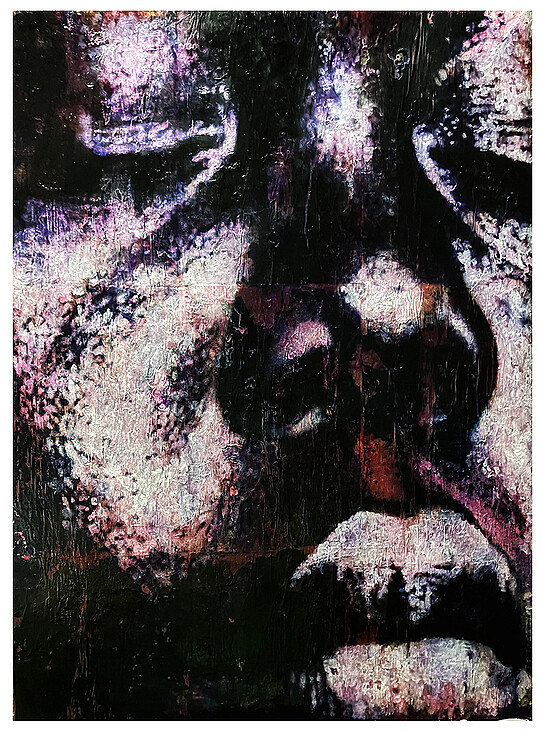
P: In Awaiting Resurrection at Pyramid Point, A Brief History of Temperature, and There is a Window in the Garden (Reprise), what drew you to pointillism as a formal strategy?
JF: Pointillism, for me, isn’t a stylistic reference but a temporal structure. Each dot is a pulse, a breath, a unit of attention. The accumulation of marks mirrors the way memory works — fragmented, layered, always in flux.
In those works, the granular surface allows the image to vibrate between coherence and dissolution. The figure and the field are built from the same material, blurring the boundary between subject and environment. That dissolution is not loss but expansion; it allows the painting to feel alive, still forming in the viewer’s gaze.
The approach is slow, patient, and devotional. It turns labor into light, repetition into revelation. It’s a way of measuring time through touch — of making the surface itself a record of persistence.
P: You recently completed a residency at the McColl Center and are soon beginning the Slavery North Fellowship at UMass. Do each of these residencies mark a shift in your practice? What inquiries are guiding your work next?
JF: Residencies create thresholds — moments of suspension that allow reflection and redirection. At McColl, I began to think about painting less as a flat surface and more as a structure — something that has its own architecture, its own capacity to occupy space and affect the environment around it. That shift wasn’t just formal; it was philosophical. I started to ask what happens when the logic of painting moves beyond depiction and begins to act like an organism — something built, something that stands, that leans, that lives in the room with you.
This has led me to think about how the work can move toward the sculptural without abandoning its identity as painting. How can I create images that breathe in three dimensions? How can I push the edges of the frame until it becomes part of the work’s logic rather than its boundary? These questions are about structure, but also about ontology — about what a painting is and what it can hold.
The upcoming Slavery North Fellowship extends this line of thought into material and historical space — into how structures of the past, both architectural and social, continue to shape the present. I’m interested in how those histories of construction, extraction, and repair might inform how a painting is built.
In that sense, my inquiries now are about building paintings that think like bodies — structural, porous, and responsive. I’m trying to understand how the act of painting might evolve into a form of building, how the image might begin to inhabit the same dimensionality as memory or atmosphere. The work is still grounded in care, presence, and responsibility, but the questions are expanding. The spell is learning how to stand.